
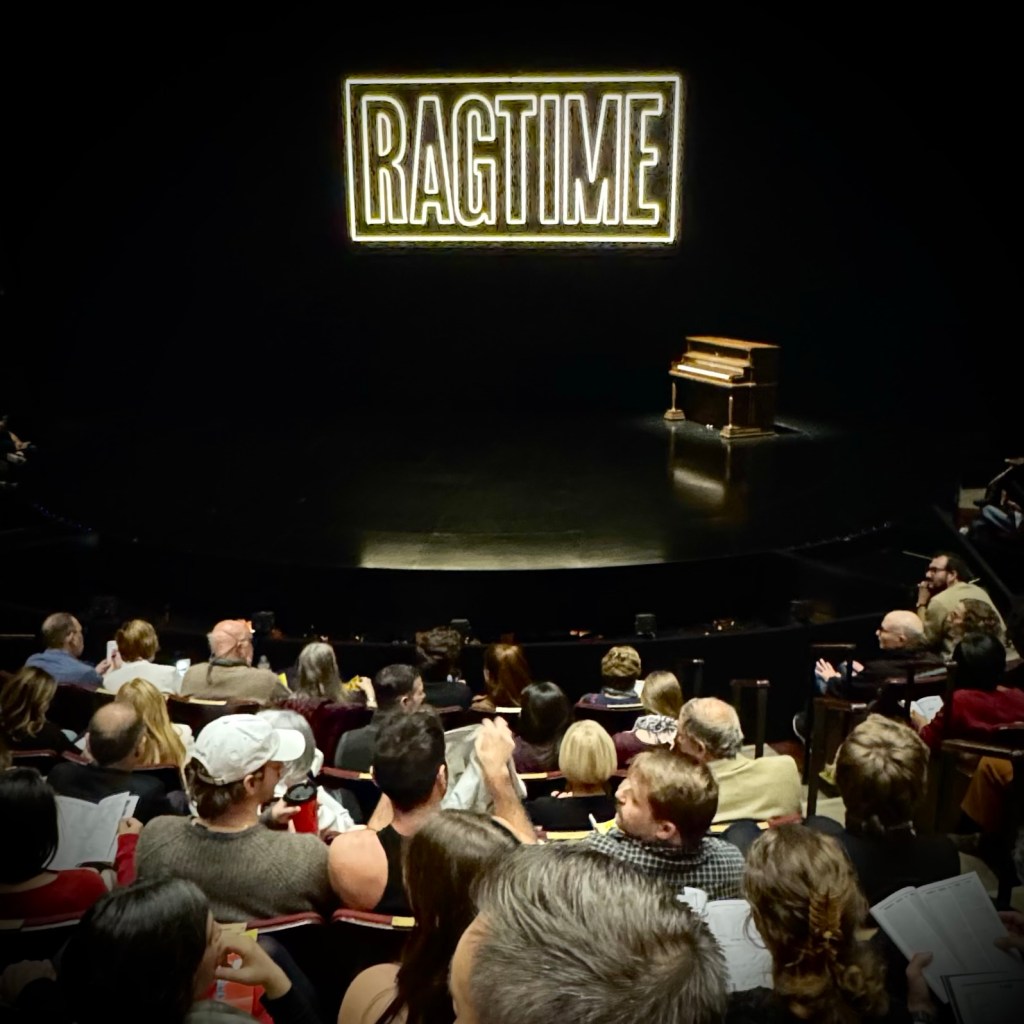
I didn’t realize that shows talk to each other until they followed me out of the theater. I was in New York for my birthday, doing the thing that has always steadied me. Sitting in the dark, waiting for the lights to come up. Broadway has always felt like a place where something might tell the truth if you listen closely enough. I came for Ragtime. That was the reason. The others came later, almost casually, the way decisions do when you don’t yet know they’re going to follow you home.
Chicago came next. I wanted to see Alex Newell. And MJ, that one felt like a compromise. I figured it was the only show I could drag my boyfriend to that might keep him awake. I was wrong. He dozed through parts of the first act, head tipping forward in that familiar way, the music washing over him without landing. But something shifted and by the second act. He sat up. Paid attention. By the end, he was in it.
So was I.
What I didn’t expect was how clearly the three shows would begin speaking to one another. Not in plot. In burden.
I went into Ragtime expecting excellence. And I got it, well technically. The voices were powerful. The singing was undeniable. That part was never in question. What I found myself craving, though, was something quieter and harder to manufacture: interior life.
Joshua Henry as Coalhouse Walker, Jr came onstage fully formed, fully righteous, fully wronged and somehow still distant. The performance felt less like a man being lived in and more like a man being demonstrated. His rage and frustration were recognizable, almost familiar in the way audiences like things to be familiar. I couldn’t shake the feeling that the portrayal was calibrated outward, shaped for recognition rather than intimacy. It’s as if the role was asking the audience to nod knowingly instead of sit uncomfortably.
That distance mattered to me. Because Coalhouse isn’t a symbol first, he’s a man. A Black man whose dignity costs him everything. I wanted to feel him breathing. I wanted to see the private grief underneath the public defiance. Instead, I felt the presence of an actor standing slightly apart from the role, performing at Coalhouse rather than inhabiting him.
Maybe that distance was intentional. Maybe it was a choice meant to say something. But if it was, it came at the expense of depth. I kept thinking about performances I’d seen before even only online of Brian Stokes Mitchell. He portrayed how inevitability can feel when it’s earned, how restraint can devastate more than volume ever could.
Sarah, too, felt slightly miscast to me. Her voice was beautiful, undeniably so, but her pain never fully arrived. Some sorrow needs time inside it. Some grief requires weight, years lived, disappointments layered. The chemistry hovered at performance, never quite settling into tragedy.
Ironically, it was Mother who grounded me. Her discomfort. Her restraint. Her willingness to sit inside contradiction. Tateh, too, felt lived in, tender in a way that didn’t ask for applause.
When the curtain call came, the audience rose, applauding resolution. Mother was celebrated as a moral center, a kind of hero. I understood the impulse. But my heart broke for the little black boy.
Because no matter how generous the ending tries to be, no white woman no matter how well-intentioned can protect that child from what the world is preparing to ask of him.
Ragtime tells us it’s a story about three families. Sitting there, all I could see was the boy who never speaks. The one who watches everything. The one who inherits the lesson without ever being consulted.
The white characters are rewarded with narrative closure. New love. New work. New beginnings. We’re invited to feel relieved because the boy now has a new family as if wealth can replace safety, as if proximity can substitute for protection.
Someone might argue he comes out ahead. Richer parents. More opportunity.
But that boy has already been set up to fail.
Evelyn Nesbit kept appearing in my mind long after Ragtime ended. Not because she dominates the story but because she doesn’t have to. History bends around her. The damage follows someone else.
She is young, beautiful, reckless, and devastating in her orbit. Men destroy themselves over her. Violence erupts in her wake. And yet she remains untouched in the way that matters most. Protected. Absorbed back into the story. Allowed to continue.
Evelyn isn’t punished for chaos. She is insulated by it.
Watching Ragtime now, I couldn’t stop thinking about how easily her recklessness is absorbed by the world compared to Coalhouse Walker’s restraint. Coalhouse is careful. He is dignified. He follows rules that were never designed to save him. And when he finally refuses to bend, when his grief becomes inconvenient, he is removed. Cleanly. Permanently.
Evelyn’s harm lingers. Coalhouse’s ends.
That contrast doesn’t feel accidental. It feels instructional.
Which is why Chicago felt less like satire and more like confirmation.
Chicago simply makes explicit what Ragtime keeps polite.
Roxie Hart and Velma Kelly move through the world the way Evelyn Nesbit does chaos trailing behind them, consequences slipping off. They are allowed to be messy, selfish, reckless. Their violence becomes entertainment. Their survival feels inevitable.
They are not punished for their instability. They are rewarded for how well they perform it.
And when they are finally “discarded,” it is temporary. They walk out of jail. They regain agency. What they chase next isn’t freedom, it’s attention.
They mistake fame for liberation.
Chicago made its point loudly, unapologetically. Spectacle over substance. Performance over truth. Velma is celebrated until Roxie arrives, then pushed aside. But the difference mattered. When Velma and Roxie are tossed aside, they are also freed, literally. They walk out of jail. They regain choice.
What they chase afterward isn’t freedom. It’s fame.
Roxie is free the moment she’s acquitted. She just doesn’t recognize it. She mistakes attention for liberation.
The audience laughs because the stakes feel low. Consequences are temporary. Chaos is entertaining.
“I’m a star, and the audience loves me, and I love them. And they love me for loving them and I love them for loving me. And we love each other. And that’s because none of us got enough love in our childhoods. And that’s showbiz, kid!” -Roxie Hart, Chicago
As soon as she uttered those words I immediately thought of Michael Jackson.
MJ landed differently.
Michael Jackson was and remains the greatest entertainer of all time. That part feels undisputed. What’s harder to sit with is how completely the world failed him.
Watching the musical, I was struck by how joyfully it moved. The music was nostalgic. The choreography electric. It was fun. But underneath the fun was something heavier, something harder to shake.
MJ represents a familiar contradiction for Black boys: loved, favored, elevated for what we can do while being quietly rejected for who we are. Valued for talent. For labor. For the ability to turn pain into pleasure. Taught early to be useful in our own minds. To understand our worth as conditional.
When we can no longer produce at the level demanded, we are discarded.
Unlike Roxie and Velma, Michael never gets to walk away. Fame doesn’t free him it pursues him. Haunts him. Consumes him. Where they hunger for the spotlight, MJ spends his life trying to survive it.
That was the question that followed me out of the theater and back into the cold New York night:
What does freedom even look like for a Black man if fame, money, and global adoration couldn’t make the greatest entertainer who ever lived free?
And that’s why my heart broke for little Coalhouse Walker III at the end of Ragtime. Watching. Silent. Carrying a future he didn’t choose. In a world full of promise, already learning the same lesson as Coalhouse and, later, as Michael: that survival will be demanded long before freedom is ever offered.
By the end of the weekend, the connection was unavoidable.
Coalhouse is removed once his dignity becomes inconvenient.
The boy in Ragtime watches and learns.
Michael grows up and carries the lesson to its most brilliant, most tragic extreme.
And America calls it progress.
Progress imagined as adoption. Assimilation. Reassignment. Never justice. The system remains intact. Only the burden changes hands.
I came to Broadway for my birthday expecting to celebrate. I left carrying something else.
Some stories raise you. Others teach you how to survive.
Too many Black boys are taught the second lesson first.
And this writing is my way of saying:
I see you.
 The Black Playbill
Leave a comment